Feed contracts: catch upstream changes before they break an interface
By BioDream Developer, BioDream LLC
The expensive part of an interface is rarely building it. It is the day the sending system changes. A vendor upgrade drops a field. A new code appears in a coded field. A segment starts repeating. None of those is an error: the messages are still valid HL7, every engine accepts them, and nothing notices until a receiving system falls over weeks later and the investigation starts from the wrong end.
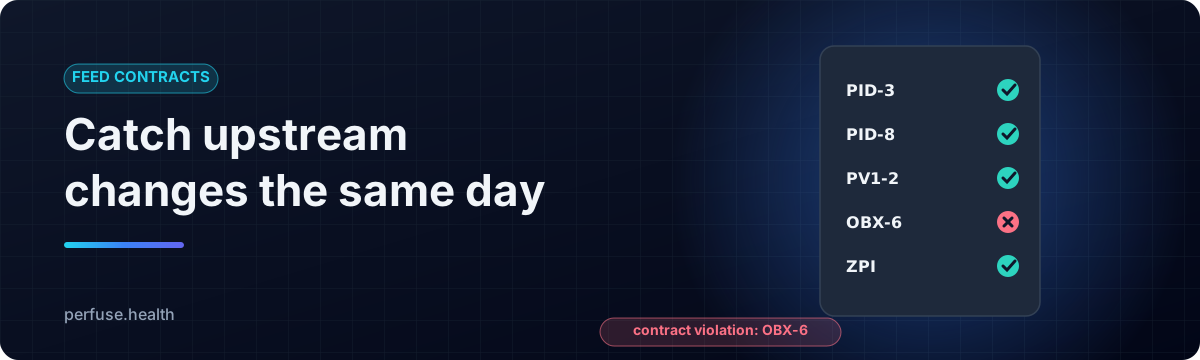
Feed contracts close that gap. A contract says what a feed is supposed to contain, and the engine tells you the day reality drifts.
Start from what you actually receive
Interface specifications are usually years old. The real feed has the three Z-segments the site added later, the field that is always empty, and the code nobody documented. So the starting point is the traffic itself.
Expectations as rates
Real feeds contain a small share of genuinely odd messages: a vendor test message, a patient with no recorded sex, a manual entry. A contract that fires on each one trains people to ignore it. So a good expectation is a proportion: the medical record number is populated in at least 99% of messages. One odd message in ten thousand never fires. Five percent of messages losing their medical record number does.
How Perfuse does it
Perfuse is a free, Apache-2.0 healthcare integration engine with feed contracts built into every channel.
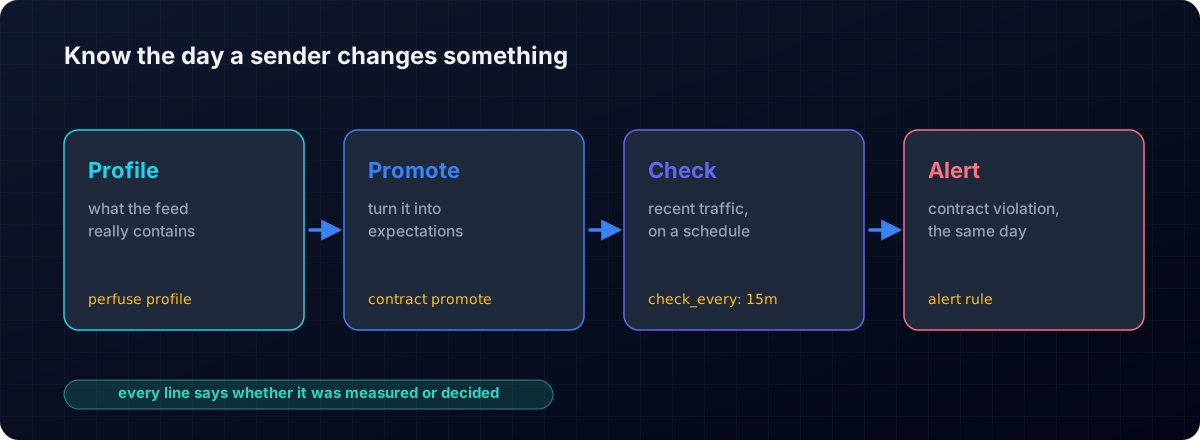
1. Profile the feed
perfuse profile messages/Reports which fields are always populated, which never are, the real value sets of coded fields, repetition counts, and which segments are outside the standard. Patient data stays private: values are reported only for fields whose values form a small code set.
To see what changed since last month:
perfuse profile -save last-month.json messages/
perfuse profile -against last-month.json today/
2. Promote it into a contract
perfuse contract promote -o adt.contract.yaml messages/Every line of the generated contract says whether it was measured or decided, so pruning it to what matters is quick:
expectations:
  - path: PID-3
    rule: populated
    min_rate: 0.99
    why: the medical record number; everything downstream keys on it
3. Attach it to the channel
name: adt-in
contract:
  file: adt.contract.yaml
  check_every: 15m
  over: 500          # profile the last 500 messages
Perfuse re-profiles recent traffic on that schedule and raises a contract violation alert when the feed stops matching. A default alert rule is included, so attaching a contract is enough.
Clear, honest results
- Too few messages reads as "not judged", never as passing, so silence is never mistaken for health.
- The alert says the sender changed, not that the engine is failing, so you look in the right place first.
perfuse contract check -strictin a cron job or a CI pipeline exits non-zero on any violation.
Alongside it
- Eleven alert types, including below rhythm, which notices a feed running quieter than its own history.
- Shadow mode for testing your own changes on real traffic.
- Shared mapping tables that record who decided each mapping and why.
All in one engine: HL7 v2, FHIR, X12, DICOM and CDA over twenty connector types, with a durable queue and a full web console, in one file with nothing else to install.
Get started
- Download Perfuse from the latest release.
- Run
perfuse profileon a folder of messages from one feed. - Read the manual for every contract rule.
Related: Shadow mode · HL7 v2 to FHIR.
Perfuse on GitHub
Perfuse is free and open source under Apache 2.0. The source, every release, the issue tracker and the full documentation are on GitHub: github.com/biodream-llc/perfuse.
- Download the latest release for Linux, macOS or Windows
- Read the source
- Report an issue or ask a question